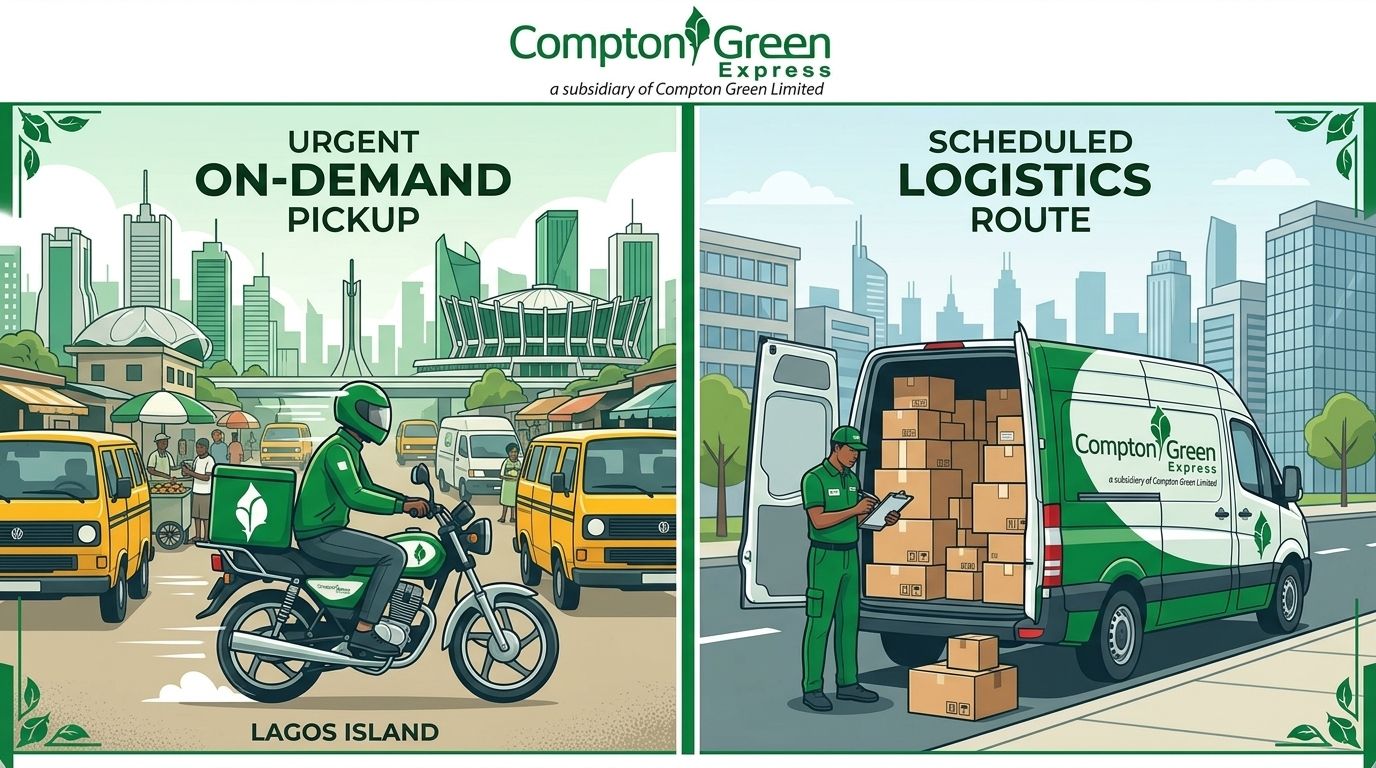
Choosing between on-demand and scheduled courier services affects your costs, delivery promises, and daily operations. Pick the wrong model and you may overpay, miss delivery windows, or slow your team down.
Compton Green Express helps Lagos businesses match courier models to real sales volume. Whether you ship 5 parcels a week or 500, the right mix of on-demand speed and scheduled efficiency keeps costs down and customers happy.
Need help choosing? Contact Compton Green Express for a free assessment of your shipping patterns and a tailored proposal.
TL;DR
- Ship less than 10 per week: start with on-demand.
- Ship 10–50 per week: evaluate a hybrid (scheduled baseline + on-demand for overflow).
- Ship 50+ per week: scheduled services usually win on cost and reliability.
- Review quarterly. If volume shifts 25%+ for two months, reassess your model.
Why Your Courier Model Matters
Your courier setup controls three things: what you pay per delivery, what you can promise customers, and how much time your team spends coordinating shipments.
The Financial Impact
- On-demand is pay-per-use. You call when you need a pickup. It offers maximum flexibility but a higher per-delivery cost.
- Scheduled runs on agreed pickups and routes. You commit to regular service and get predictable pricing with lower per-delivery rates.
Using on-demand for predictable, high-volume shipping can cost 30–50% more than scheduled models. Conversely, paying for scheduled pickups you do not use wastes money on empty capacity. The goal is to match model to volume.
Customer Expectations Drive Decisions
Customers expect speed and reliability as standard.
- On-demand excels for urgent, same-day needs. It helps close time-sensitive sales.
- Scheduled shines for consistency. If you ship daily or several times per week, scheduled pickups move parcels without manual coordination.
Your model sets what you can promise—and how reliably you can deliver.
Operational Complexity
- On-demand requires coordination for each pickup. Fine at low volume, a bottleneck as you grow.
- Scheduled reduces overhead. Your team prepares in advance and standardizes the handoff.
For scaling businesses, these efficiencies become a major advantage.
Understanding On-Demand Courier Services
On-demand services provide pickup and delivery when you request them, usually with quick turnaround.
How On-Demand Works
You contact the courier when a package is ready. The courier confirms availability, quotes a price based on distance, urgency, and package details, then dispatches a rider or driver. Response times vary: many offer 60–120 minutes, with premium options faster for a higher fee. Pricing includes a base fee, distance, and any extras such as insurance or guaranteed windows.
When On-Demand Makes Sense
- Low volume (under ~5 shipments per week): pay only when you ship and avoid minimums.
- Unpredictable demand: project-based, custom manufacturing, or seasonal spikes.
- Urgent and time-critical deliveries: spare parts, legal documents, medical items.
- Geographic flexibility: changing pickup points, multiple sites, or pop-up locations across Lagos.
On-Demand Limitations
- Higher per-delivery cost (often 20–50% more than scheduled).
- Variable availability during peaks (public holidays, heavy rain, major Lagos events).
- More admin per shipment: quotes, bookings, and separate transactions.
Understanding Scheduled Courier Services
Scheduled services operate on predetermined pickup times and frequencies, usually under a contract.
How Scheduled Works
You agree pickup days and times—daily at 3 pm, three times a week, or a custom rhythm. Your location is added to the route, and drivers arrive at the agreed time. Pricing often reflects your committed volume, with discounts, monthly pickups, or custom terms. Many providers also allow on-demand add-ons for exceptions.
When Scheduled Makes Sense
- Consistent, predictable volume: daily or several times per week.
- Cost optimization at higher volumes: bulk rates and volume discounts can cut costs 30–50% vs. on-demand.
- Operational efficiency: predictable pickups reduce errors and free staff time.
- Strong logistics partnerships: ongoing relationships improve service and flexibility.
Compton Green Express builds long-term partnerships with Lagos businesses to deliver consistent service and responsive support as your needs evolve.
Scheduled Considerations
- Volume commitments: you may pay even when you underutilize.
- Less timing flexibility: requires disciplined internal processes.
- Geographic constraints: multi-site pickups across Lagos may need multiple arrangements or a hybrid approach.
Options and Trade-offs
Most businesses combine both models.
Hybrid Models
Use scheduled pickups for baseline volume and on-demand for overflow or urgent orders. Example: schedule a 4 pm daily pickup for standard orders and request morning on-demand collections for priority shipments.
Volume-Based Pricing
Some providers lower per-delivery rates as monthly volume rises, even without fixed schedules. This suits consistent monthly totals with uneven daily patterns.
Route-Based Discounts
If you repeatedly ship along the same corridors or areas of Lagos, negotiate better on-demand rates without a formal schedule.
Cost vs. Flexibility
- On-demand: more flexibility, higher unit cost.
- Scheduled: lower unit cost, less flexibility.
Choose based on:
- Sales volume patterns (consistent vs. variable)
- Average order value (can higher courier spend be justified?)
- Delivery promises (same-day vs. next-day windows)
- Internal capacity (team size, process maturity)
- Growth trajectory (near-term scaling)
- Cash flow (predictable vs. variable costs)
Compton Green Express can analyze your shipping data and recommend the right mix for your Lagos operations.
How to Choose the Right Fit
Make a clear assessment of your current needs and near-term plans.
Analyze Your Shipping Patterns (3–6 Months)
- Volume: average per day/week/month; peaks; min/max; trend.
- Timing: share of same-day; order-to-ship windows; SLAs; prep time.
- Geography: pickup sites; destination patterns; local/state/national split; common Lagos areas and local government areas (LGAs).
Calculate Total Cost of Ownership
Compare full costs—not just the rate card.
- Direct: per-delivery fees, volume discounts, surcharges, insurance, special handling.
- Indirect: staff time, tech/integration, packaging workflow, opportunity cost of delays.
- Risk: lost sales from capacity gaps, churn from failures, penalties, or unused scheduled capacity.
Model three scenarios using your data:
- All on-demand at current volume
- Scheduled at current volume
- Hybrid (scheduled baseline + on-demand overflow)
Choose the lowest total cost that still meets service promises.
Assess Your Growth
- Early stage (<10/week): on-demand for flexibility. Avoid paying for unused capacity.
- Growing (10–50/week): evaluate scheduled options; hybrid often wins.
- Established (50+/week): scheduled with negotiated terms typically best.
Align to Customer Promises
- Offering same-day? You need reliable on-demand with guaranteed pickup windows.
- Promising next-day with evening cutoffs? Confirm courier cutoffs and network capacity.
- Consider Lagos traffic. A 4 pm pickup may be too late for certain same-day or next-day routes during peak hours on the mainland or the Island.
Evaluate Providers
For on-demand:
- Typical pickup response, peak capacity, coverage, tracking tech, transparent pricing.
For scheduled:
- Flexibility on times, volume commitments and penalties, backups, contract terms, reporting.
For both:
- Delivery success rates, insurance and claims, support responsiveness, integrations, relevant references.
Implementation Checklists
If You Choose On-Demand
Process
- Authorize who can book and spending limits.
- Standardize packaging, labels, and documents.
- Maintain accounts with 2–3 providers for backup.
- Enable tracking and customer notifications.
Cost Control
- Set per-delivery cost caps needing approval.
- Track monthly spend vs. budget.
- Review costs quarterly for optimizations.
- Check volume monthly to see if scheduled would now save money.
Performance
- Track on-time pickups and delivery success by provider.
- Log issues and address trends quarterly.
If You Choose Scheduled
Operations
- Align prep times to pickups and create a missed-pickup playbook.
- Set clear communication with your courier contact.
- Train staff on handoff and packaging standards.
Contract
- Document volume commitments and minimums.
- Understand billing cycles and terms.
- Monitor cost per delivery vs. an on-demand baseline monthly.
- Set a 90-day reminder before renewal.
Utilization
- Batch orders to maximize each pickup.
- Track utilization and adjust frequency.
- Renegotiate if volume shifts.
If You Choose Hybrid
Allocation Rules
- Define what goes scheduled (orders before cutoff) and what goes on-demand (urgent, late, special handling).
- Set exception criteria and approvals.
Cost Tracking
- Track scheduled and on-demand separately.
- Calculate blended cost per delivery and compare to pure models.
- Adjust rules if one side becomes too expensive.
Risk Mitigation
- Keep backup providers for both models and test them occasionally.
- Verify insurance limits match shipment values; know claims steps.
- Set minimum service levels and review monthly.
Make the Decision Work Long-Term
Your courier model should evolve with your business.
Quarterly Reviews
- Actual vs. projected volume
- Total and per-delivery costs
- Service performance and CSAT
- Growth plans and new requirements
Triggers to Reevaluate
- Volume shifts of 25%+ for two consecutive months
- New customer SLAs or large accounts
- Geographic expansion (new sites, outside Lagos State)
- Strong seasonality requiring flexible schedules
Build Strong Partnerships
- Communicate projections, peaks, and plans.
- Give clear feedback to improve service.
- Consolidate volume where it helps, but keep backups to reduce risk.
Lagos-Specific Factors
- Traffic and timing: avoid mid-afternoon gridlock on major routes like Lagos-Ibadan Expressway, Third Mainland Bridge, and Apapa corridors; consider early morning or post-7 pm pickups.
- Area coverage: ensure strong performance in your target LGAs—Lagos Island, Victoria Island, Lekki, Ikeja, and surrounding areas.
- Peak season: allow extra buffer around yuletide, public holidays, and major events when traffic and demand surge.
FAQs
- When should I switch to scheduled? Start evaluating at 10–20 per week; at 30+ per week, scheduled usually wins. Include staff time in the math.
- Can I mix both? Yes. Use scheduled for baseline and on-demand for urgent, overflow, or late orders.
- How fast is on-demand in Lagos? Commonly 60–120 minutes, longer during rush hour or in traffic-heavy corridors. Premium options are faster for a fee.
- Biggest cost lever? Consistent volume plus scheduled pickups. Batching orders into one or two daily dispatches also helps.
Take the Next Step with Compton Green Express
The right courier model should align with your sales volume, customer promises, and operational capacity. For most growing businesses, the best answer is a strategic mix that adapts as you scale.
Start now:
- Document shipping patterns for the last three months.
- Compare total costs across on-demand, scheduled, and hybrid.
- Speak with a provider that can match your exact needs.
Compton Green Express offers on-demand and scheduled courier services across Lagos, plus flexible hybrid models. What we provide:
- Fast on-demand response for urgent deliveries
- Reliable scheduled routes with consistent pickup times
- Hybrid flexibility aligned to your real shipping patterns
- Transparent pricing with volume discounts as you grow
- Lagos expertise across traffic patterns, key zones, and optimal timing
Contact Compton Green Express for a free shipping assessment and a tailored proposal within 24 hours.
- Phone/WhatsApp: +234 808 430 0010
- Email: comptongreenexp@gmail.com
- Website: https://www.comptongreenexpress.com
- Address: Agbeke House, 107 Bamgbose Street, Lagos Island, Lagos
Your logistics should drive growth—not limit it. Choose the courier model that positions your business for success.
Leave a Reply